Would Anyone Pay for My App? How to Check Before You Build
How to test whether people value your app enough to pay, using alternatives, switching reasons and small real commitments.
How do I know if people will pay for my app?
Look for three things: people already spend time or money on the problem, they have a clear reason to switch from what they use now, and some of them make a small real commitment (a purchase, a clearly explained pre-order, or meaningful effort in a trial) before the app exists.
Ask about the past, not the future
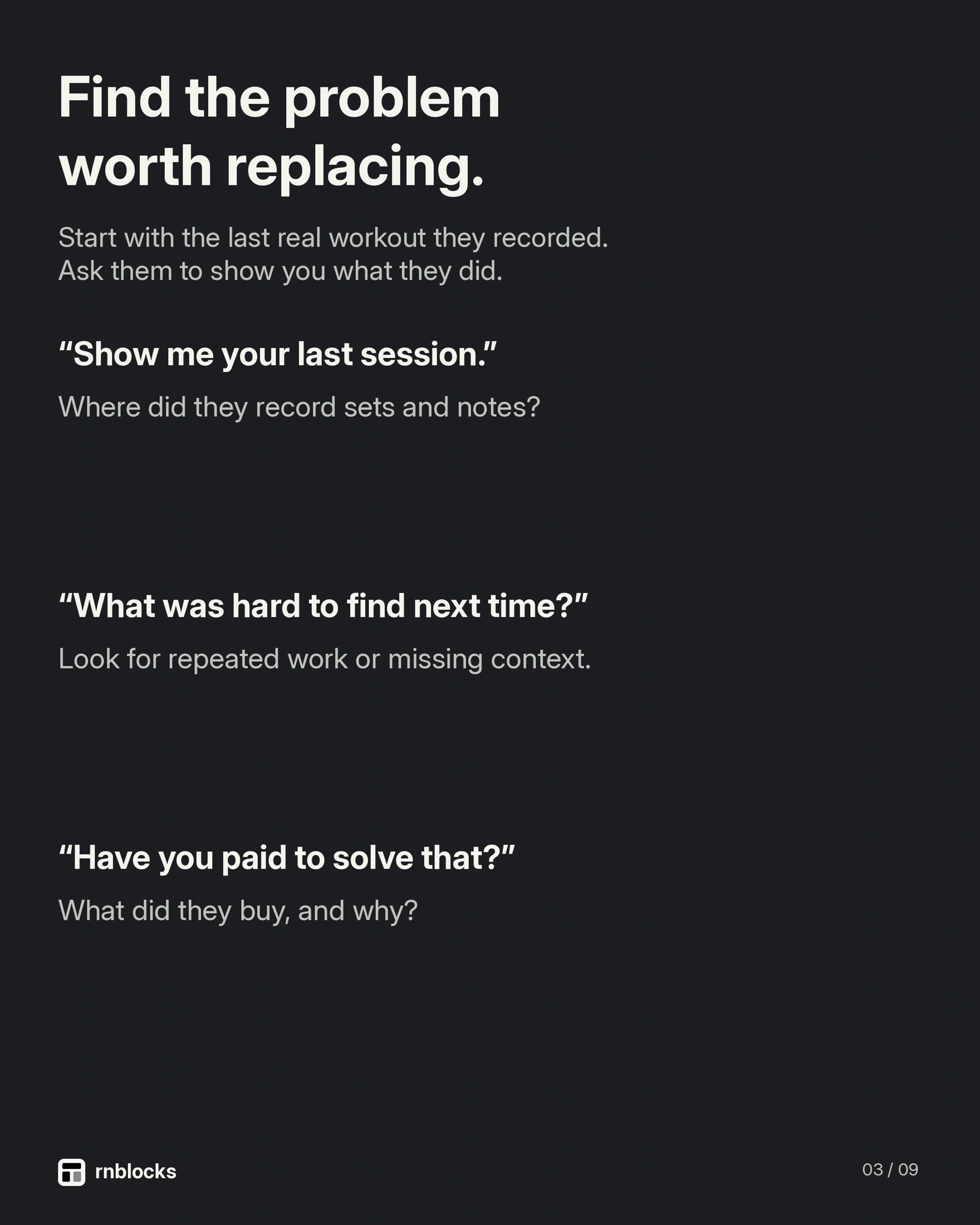
"Would you pay for this?" gets polite yeses. Instead ask: "How do you handle this today? What does it cost you? When did you last try something else?"
Know what you compete with
The alternative is often not another app. It is a spreadsheet, a notes app, a paper list or doing nothing. Your app must beat that by enough to be worth the switch.
Small commitments that mean something
- An email sign-up after seeing a clear description and price.
- A paid pre-order or deposit, refundable if you do not ship.
- Ten people agreeing to test a prototype this week.
Would you pay for your own app?
Honestly answer: would you pay the price you plan to charge, every month, for what the first version does? If not, narrow the audience or strengthen the main task.
Separate interest from a purchase
Someone liking an app idea, joining a waitlist and paying for it are different signals. All can be useful, but they do not prove the same thing. A free email sign-up should not be presented as evidence that a person accepted a subscription price.
Define what you are trying to learn before the test. Is the problem real, is the proposed solution useful, or will someone pay a particular amount for it? One experiment rarely answers all three.
Ask for the last real example
If you are considering an invoicing app, ask how the person sent their most recent invoice, what went wrong and how they followed up. Ask what they already pay for and what work they do manually.
Avoid describing your solution so enthusiastically that the person starts trying to please you. An inconvenient recent example teaches more than a hypothetical promise to download.
Make the offer concrete
'A useful finance app' is hard to evaluate. 'Track unpaid invoices and prepare a weekly follow-up list for $8 a month' gives someone a task and a price to consider.
Show a prototype or small working version that demonstrates the promised outcome. Be clear about what exists, what is still being built and what any payment would cover. If you accept pre-orders, explain delivery expectations and refunds.
Watch for switching effort
People may already have data, habits and collaborators in another tool. Your app needs enough benefit to justify moving, or a low-risk way to work alongside the existing process.
A spreadsheet that takes ten minutes a week can be difficult competition for a subscription that saves only two. A manual process causing missed payments may create a much stronger reason to change.
Keep a small evidence sheet
| Evidence | What it suggests |
|---|---|
| Compliment | The idea sounds appealing |
| Detailed recent problem | The need exists for this person |
| Scheduled trial with real data | Willingness to spend effort |
| Repeated use | Some ongoing usefulness |
| Purchase or clear paid commitment | Stronger evidence about the offer |
Record objections as well as positive reactions. 'Too expensive' may mean the benefit is unclear, the audience is wrong or the price genuinely does not fit. Ask what makes it hard to justify.
Decide the next experiment
If the need is real but the solution is confusing, improve the task. If people use it but will not pay, test the offer and audience. If nobody encounters the problem recently, reconsider before adding more features.
Is a waitlist worth creating?
It can help collect interested people and recruit trials. Show a clear description and ask only for information you need. Treat signups as permission and interest according to the stated terms, not as proof of payment.
Should I ask friends?
Ask them when they match the audience or can introduce you to someone who does. Supportive reactions from people without the problem are encouraging but weak evidence about the business.
What if someone says the price is too high?
Ask what they compare it with and which result would justify paying. The issue may be price, unclear value, switching effort or the wrong audience. Do not immediately add features without understanding the objection.
Can I test without taking money?
Yes. You can test task usefulness, willingness to share realistic inputs or willingness to schedule a trial. Those are valuable signals, but they do not answer the payment question as strongly as an actual purchase.
What should I avoid claiming?
Do not turn a small trial into a made-up conversion benchmark. Report what happened: how many people saw the offer, what they tried and which commitments they made. If you change the offer, keep the results separate so you know which version people responded to.
Keep the offer and experiment aligned
If you show a free prototype, you are mainly learning about interest and usability. If you show a clear paid offer, you can learn about that offer as well. Do not combine the results as though everyone saw the same proposition. Record the version, audience and next action requested so you can understand what any response actually supports.
Build it with RNBlocks
A working example makes a pricing conversation less hypothetical. Start free in RNBlocks, build the narrow task and let the intended audience try it. Use what they do and commit to as evidence before expanding the product or its paid offer.
Ready to build?
Build, connect and publish iOS and Android apps with AI.