
My App Idea Already Exists. Should I Still Build It?
Finding your idea already exists is usually good news. How to find the gap that makes yours worth building.
Should I still build my app if the idea already exists?
Often, yes. An existing app shows a category exists, but does not prove demand for your particular version. The question is not "does it exist?" but "who is it failing, and why?" Build for a specific audience, problem or situation the existing apps serve badly, and you are not competing with them head-on.
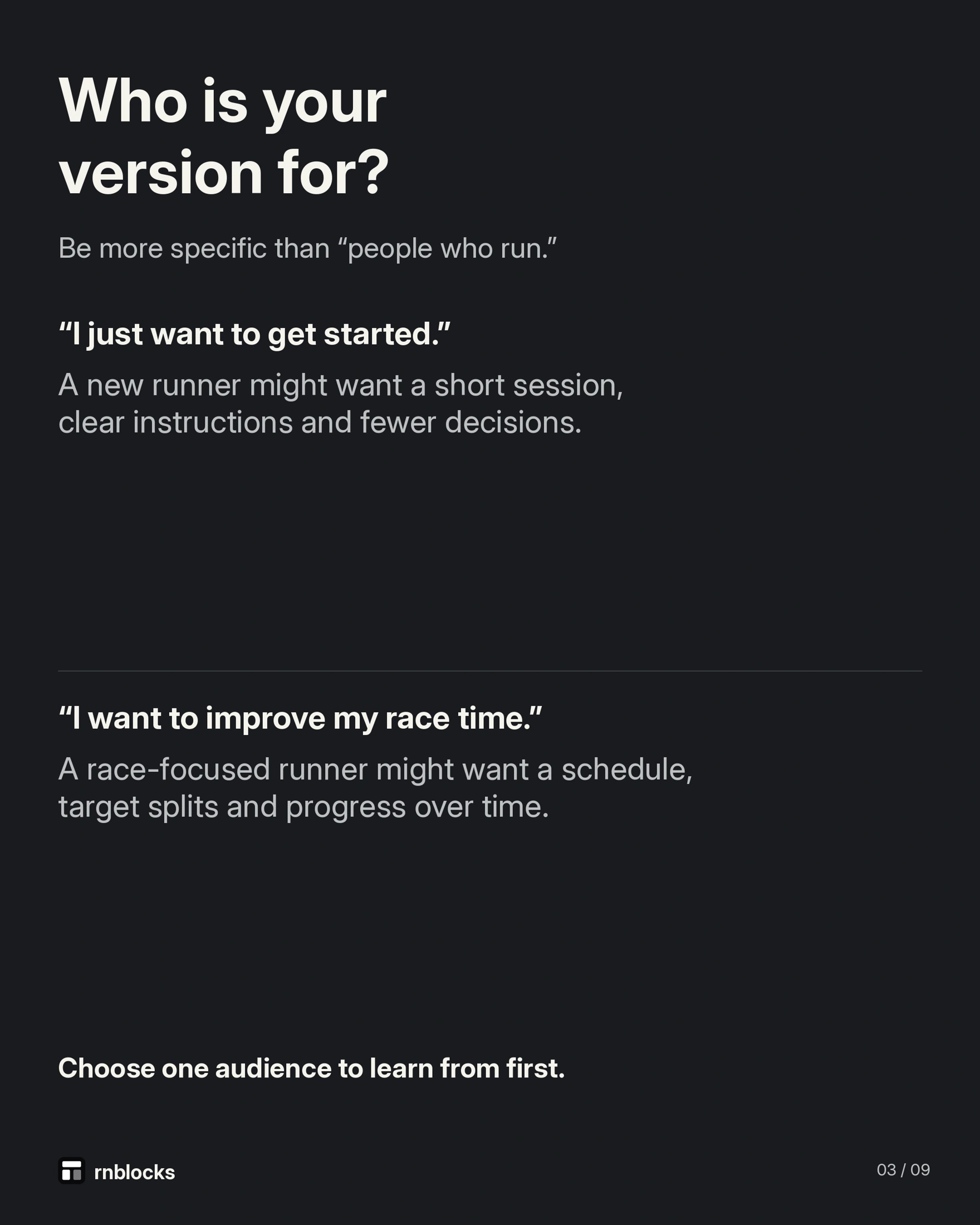
Where to look for the gap
- Read the 2 and 3-star reviews of existing apps. They name what people wanted and did not get.
- Pick a narrower audience: a habit tracker for shift workers, a budgeting app for freelancers with irregular income.
- Pick a different situation: the same task, but offline, in another language, or for a team instead of one person.
- Make one thing much simpler than the incumbent.
Signals it is worth building
- People complain about the same missing thing again and again.
- People already use a workaround: spreadsheets, notes apps, group chats.
- You can name the first 10 people who would try it.
Signals to rethink
- Reviews are mostly happy and the app is free.
- Your only difference is a nicer design.
A quick test before building
Write one sentence: "For [audience] who [situation], unlike [existing app], mine [one difference]." Show it to five people in that audience and watch their reaction.
Competition is evidence of a category, not proof of your demand
An existing app shows that someone built a solution. It does not prove that your chosen audience will use or pay for another one. Look for people with a specific unmet need, then investigate how often that problem occurs and what they do about it.
For example, a general budgeting app may work well for salaried employees but make irregular income awkward. A freelancer's problem might be planning around uncertain invoice dates, not needing another spending chart.
Read complaints for the situation behind them
'Needs a calendar' could mean someone cannot see upcoming bills. 'Too complicated' could mean a new user cannot finish their first budget. Record the task, the person and the consequence, rather than turning every complaint into a feature list.
Look across more than one source and include positive reviews. A few unhappy comments can reveal a problem without telling you how common it is. Do not turn self-selected reviews into a claim that most users are dissatisfied.
Write a testable difference
Compare these two ideas:
- 'A better budgeting app with AI.'
- 'A simple cash-flow view for freelancers that separates confirmed income from unpaid invoices.'
The second explains who it helps and what changes. It also suggests a small prototype: add an invoice, mark it paid and see how the available balance changes.
Check the cost of switching
A person may dislike their current app but still rely on its history, integrations or familiar workflow. Ask what they would need to bring with them and what would make trying your version safe.
You may discover that a small companion tool is easier to adopt than a complete replacement. You may also find that the problem is annoying but not important enough to solve. Both are useful outcomes before a long build.
What to do this week
Choose one audience and speak with a few people who recently experienced the problem. Ask them to show the last occurrence and their workaround. Build a narrow example only after the task is concrete.
Watch someone use it without explaining every step. A polite reaction to the idea is weaker evidence than a person returning to solve the same problem again.
Build because you understand a worthwhile difference, not because competition is absent. Equally, do not abandon a useful idea simply because another product occupies the category.
Is a narrower audience always better?
A narrower audience helps only if it has a meaningful common problem and you can reach it. A tiny group chosen merely to avoid competitors may not support the product. Investigate the need and how people currently solve it.
What if the competitor is free?
Free changes the switching decision, but does not eliminate every opportunity. People can still value a better fit, simpler task or appropriate support. Prove the difference with actual use rather than assuming someone will pay for a nicer appearance.
Should I copy the features people request?
Understand the problem first. A complaint about exporting may concern collaboration, record keeping or offline access. A smaller different solution could help more than reproducing the requested feature literally.
How many interviews prove demand?
There is no universal count that proves it. A few conversations can expose assumptions and shape a test. Repeated behavior and real commitments provide stronger evidence than collecting a fixed number of polite yeses.
A concrete next step
Write the audience, recent problem, current workaround and smallest useful difference on one page. Show a focused prototype to people who experienced that situation. Record what they do, what they refuse and what would make switching difficult. Use the result to continue, narrow or reconsider the idea.
Look for a reachable first group
A clear unmet need is easier to test when you can speak to the people who experience it. Identify a community, workplace or existing relationship where an appropriate conversation is possible. Respect its rules and ask about the task before promoting a solution. Distribution is part of validating the opportunity, not something to postpone until every screen is finished.
Build it with RNBlocks
Use RNBlocks to make the small difference tangible. Describe the audience and unmet task, then build a working first journey you can show them. Start free, watch what people actually do and refine that result before investing in a much larger app.
Ready to build?
Build, connect and publish iOS and Android apps with AI.