How to Handle Feature Requests from Your First Users
Your first users will ask for many different things. How to group requests by the problem behind them and decide what to build next.
How should I handle feature requests?
Group them by the problem behind them, not by the feature asked for. Five different requests often point to one problem. Build for the problem that matters most to the audience you are targeting, and say "not yet" to the rest.
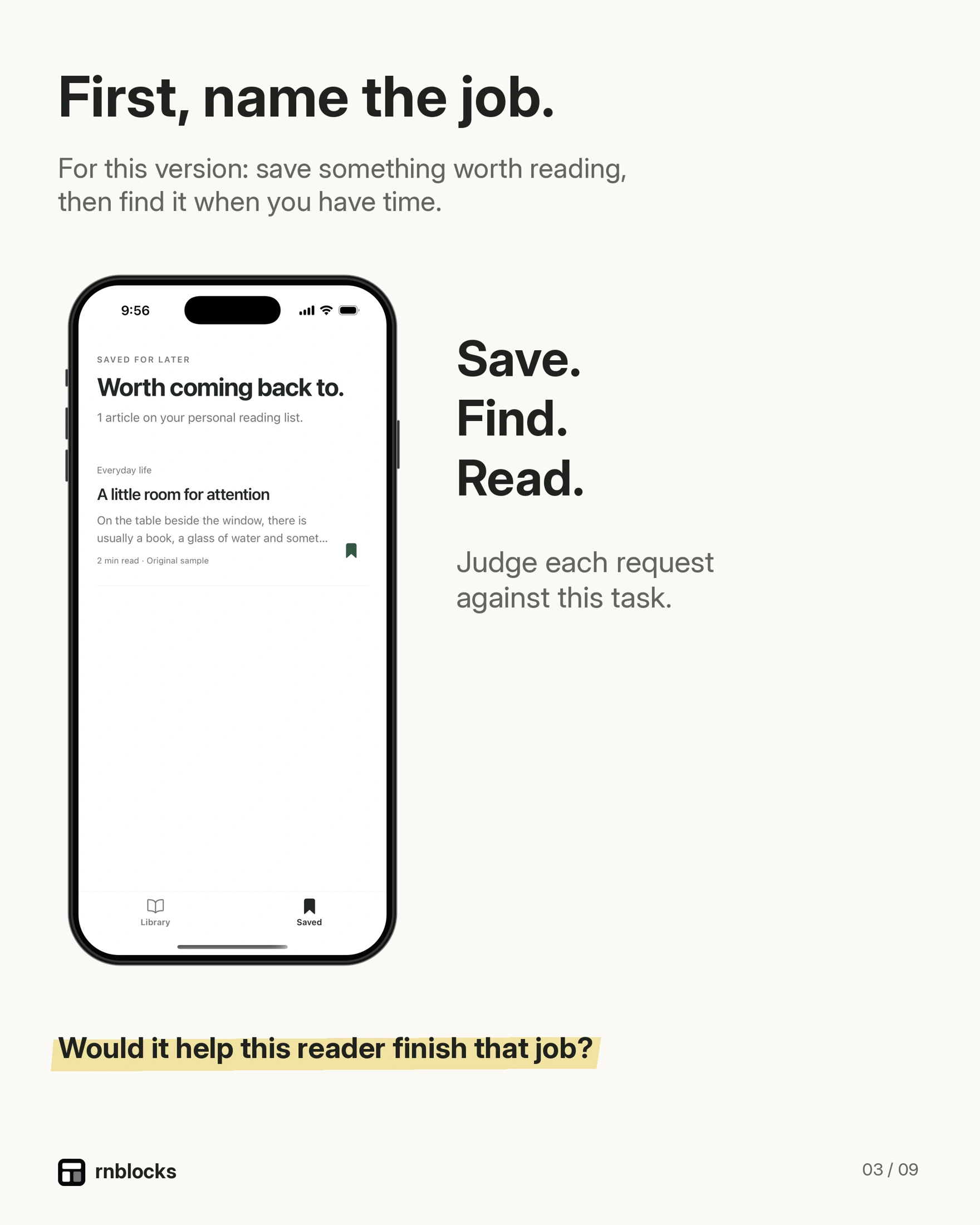
Ask "what were you trying to do?"
A request for "export to PDF" might really mean "I need to show my boss my progress". The answer might be a share link, not a PDF.
Group, then count
| Request | Problem behind it |
|---|---|
| Export to PDF | Show progress to someone else |
| Share link | Show progress to someone else |
| Weekly email summary | Show progress to someone else |
| Dark mode | Understand the comfort or accessibility need before prioritizing |
Three requests, one problem: that is your next feature.
Who is asking matters
A request from someone in your target audience who uses the app weekly counts more than one from a visitor who opened it once.
Close the loop
Tell people when you ship something they asked for. It turns users into supporters.
A request is a clue, not a specification
Someone asking for a PDF export may need a record for an accountant, a report for a manager or a document to use offline. These situations can require different solutions. Ask them to describe the last time they needed it and what they did instead.
Keep their original request, but record the underlying job beside it. This lets you compare requests without losing the context.
Separate blockers, improvements and new directions
A crash that prevents saving belongs ahead of a new dashboard. A confusing label might be cheap to fix and help many users. A request to turn a personal tracker into a team-management system may be a new product direction.
Do not treat all three as items in the same popularity contest. Consider severity, audience fit, frequency and the work needed to support the feature after release.
A more useful request log
| Field | Example |
|---|---|
| Person and situation | Coach preparing a weekly client update |
| Problem | Cannot share a concise summary |
| Current workaround | Screenshots sent in a message |
| Frequency | Every Friday |
| Possible small solution | A shareable weekly summary |
| Success check | Coach sends the update without assembling screenshots |
Store personal details privately and use anonymous summaries when discussing patterns publicly.
Do not dismiss accessibility as a cosmetic preference
A request for larger text, dark mode or reduced motion may be about comfort or access rather than decoration. Ask what makes the current experience difficult. The same feature can be a minor preference for one person and a real obstacle for another.
That does not mean building every request immediately. It means understanding the consequence before assigning priority.
Reply without promising a date you cannot keep
Thank the person, restate the problem and explain the next step. For example: 'I understand you need to send the week's progress to clients. Could you show what you include today? We are comparing a share link with an export.'
If it is outside the current scope, say so clearly. 'Not planned right now' is more honest than repeatedly saying 'coming soon.'
Check whether the shipped change solved it
Return to the people who described the problem and ask them to repeat the task. Track whether they use the feature again, not only whether they react positively to the announcement.
A feature can satisfy the literal request and still miss the need. If the coach still assembles screenshots after you add export, investigate the missing information or awkward steps before adding another format.
Should a paying customer's request always win?
It deserves attention, but still consider whether it fits the product and benefits the intended audience. A single custom workflow can create ongoing maintenance that the rest of the product does not need. Understand the business value before committing.
How can I say no without dismissing someone?
Acknowledge the task and explain the scope. You can say, 'I understand you need to send this report weekly. We are focusing on completing the core booking flow first.' Offer a suitable existing workaround if there is one, without pretending it solves more than it does.
Should I publish a roadmap?
Only if you can maintain it and make clear what is tentative. A public list can create expectations. Avoid putting every suggestion on it just to end a support conversation.
What if a request sounds easy?
Trace its dependencies. Export may require permissions, file generation, storage and sharing behavior. A notification may require device tokens and preferences. Estimate the complete feature rather than only the visible button.
Try a smaller solution first
If three requests concern showing progress to another person, prototype one concise summary. Ask the people who raised the issue to use it in their real situation. If it fails, learn which information or access is missing before implementing several output formats. This keeps the experiment tied to a problem rather than a collection of feature labels.
Keep the requester's words
Store the original wording beside your interpretation of the problem. If the proposed solution changes later, return to those words and confirm the need was understood. This reduces the risk of turning an understandable customer request into an internal feature project that solves a different problem entirely.
Build it with RNBlocks
Once you choose the underlying problem, describe that change to our agent in RNBlocks. Keep the existing working behavior clear and test the revised task with the people who requested it. The same conversation can support iteration without turning every suggestion into a new app.
Ready to build?
Build, connect and publish iOS and Android apps with AI.