How Do Apps Make Money? Free, Freemium, Subscription or Paid
The main ways apps earn money, what the App Store and Google Play take, and how to match your price to how often people use the app.
How should my app make money?
Match the model to the habit. Apps people use every week often fit a subscription. Apps used for one job fit a one-time purchase. Freemium works when the free version is genuinely useful and the paid version is clearly more. Ads need very large audiences to pay well.
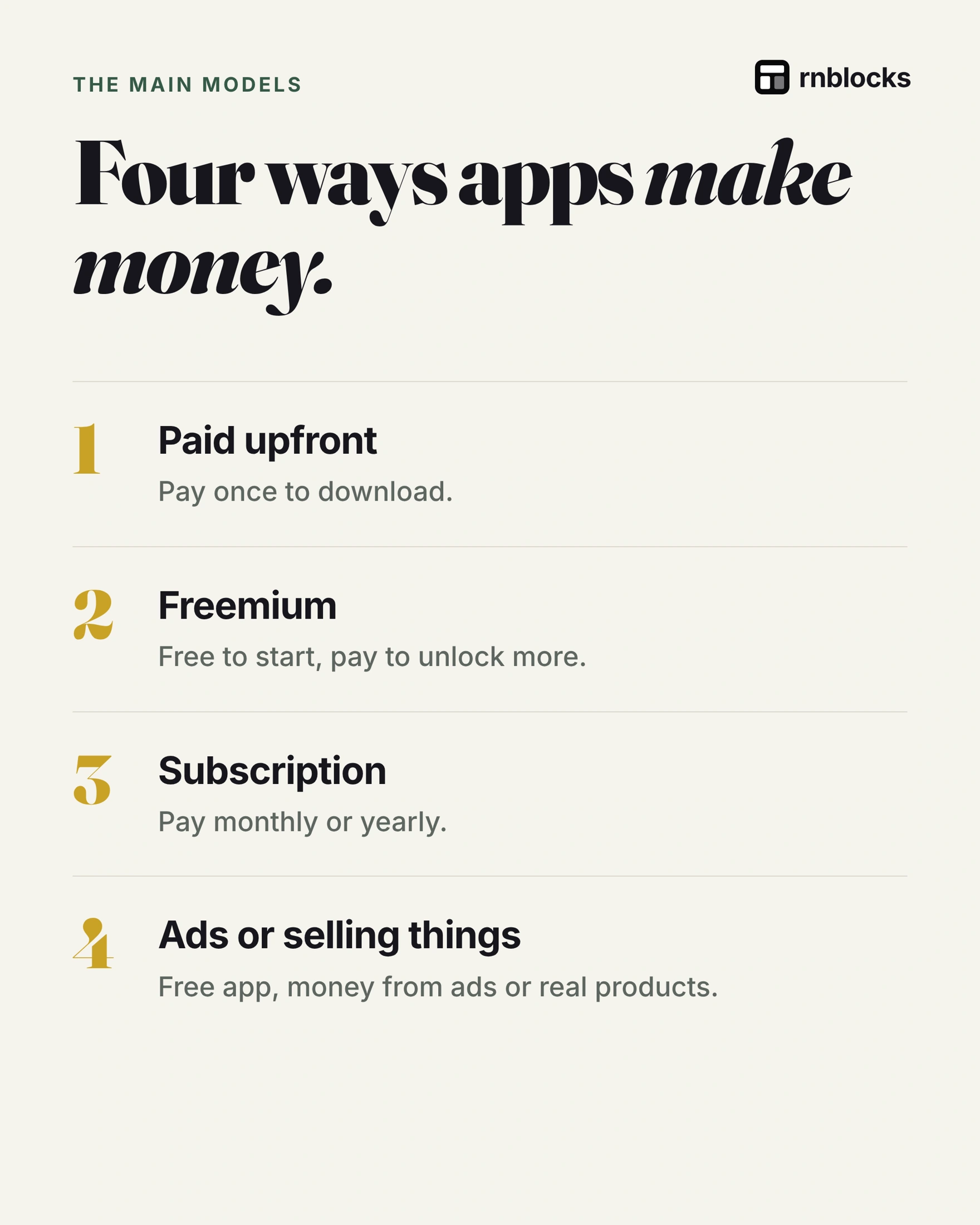
Four main models
- Paid upfront: pay once to download.
- Freemium: free to start, pay to unlock more.
- Subscription: pay monthly or yearly.
- Ads or selling things: free app, money from ads or real products.
Freemium: free gets them in, value gets them to pay
- Free must be useful: enough to see why the app matters.
- Paid must be obvious: clearly more, not a broken free version.
Subscriptions need ongoing value
- Something keeps coming: new content, syncing, an ongoing service.
- Offer a yearly plan: cheaper per month, fewer cancellations.
- Make cancelling easy: both stores require clear subscription management, and it builds trust.
The store's share
The App Store and Google Play usually take 15 to 30% of digital purchases made inside the app. Small developers can qualify for the lower rate, for example through Apple's Small Business Program. Physical goods and services such as food, rides and products use your own payment provider instead. Rules vary by country and program, so check Apple's and Google's current terms.
Before you set a price
- What would they use instead? Another app, a spreadsheet, a person.
- What is free, exactly? Write it down and be generous.
- When do you ask for money? After they have felt the value.
For a technical guide, see adding subscriptions to an Expo app with RevenueCat.
Choose a model that matches the value
A one-time calculator, a daily coaching app and a marketplace provide value differently. A subscription makes more sense when the product delivers ongoing value and has continuing costs. A one-time purchase may fit a self-contained utility. Transaction fees fit some marketplaces, but introduce payment and operational work.
Do not choose a subscription simply because recurring revenue sounds attractive. Ask why someone would still want to pay in the third month.
Model a small business before adding a paywall
Suppose your app charges $5 per month. That is revenue before store fees, taxes, refunds, payment costs and the services used to deliver the app. If one heavy user generates more than $5 of AI output each month, unlimited usage may lose money even when the app has paying customers.
Write a simple estimate for light, typical and heavy use. Include hosting, storage and external API calls. Use the providers' actual billing units rather than assuming a fixed cost per download.
Decide what people can try
| Model | What the person needs to understand |
|---|---|
| Free | Which features are included and why the app is free |
| Freemium | The useful free task and the reason to upgrade |
| Subscription | Price, renewal period and continuing benefit |
| Paid download | What they receive before paying |
| Usage credits | What consumes credits and how to buy more |
A confusing paywall can hide whether the product itself is useful. Make the first task and the paid boundary understandable. Do not use a trial label for an experience that immediately charges without clear terms.
Check the payment route before building it
Digital features and physical goods follow different store rules. Regional programs and exceptions can affect permitted checkout and links, so avoid treating one worldwide rule as universal. Match the implementation to the product, storefront and current requirements.
Test purchase restoration, cancellation, pending purchases and a subscription expiring. The person should not lose access just because they reinstalled, and your backend should not grant paid features merely because the phone reports a successful animation.
Validate willingness to pay honestly
Show a clear offer to the intended audience. Ask what they currently use, what it costs and what would make switching worthwhile. A waitlist response is interest; an actual purchase is stronger evidence. Keep those signals separate.
Start with a model you can explain and support. You can refine pricing after observing real use, but changing what existing customers paid for deserves careful communication.
Is advertising the easiest way to monetize?
It can introduce its own requirements, privacy disclosures and user-experience trade-offs. Revenue depends on audience and usage, not merely adding an SDK. For a small focused app, compare whether ads would interfere with the task more than they support the business.
Should every subscription include a trial?
Not necessarily. Decide how someone can understand the value before committing. That could be a useful free feature, a limited allowance or a clearly described trial. Make renewal terms and cancellation understandable.
What is purchase restoration?
It is the path that helps an eligible person regain purchased access, such as after reinstalling or changing devices. The implementation depends on the store and purchase type. Test it rather than assuming login alone restores everything.
What if a provider request costs more than expected?
Inspect real usage, set appropriate limits and consider whether the paid offer needs a defined allowance. Avoid advertising unlimited expensive generation unless you understand and can sustain the likely usage.
What should I measure after launch?
Track the useful task, when the offer is shown, purchases and continued use. Keep refunds and support issues visible. A high number of paywall views with few purchases may reflect the audience, value, timing or a broken payment journey. Investigate before increasing the price or adding more prompts.
Build it with RNBlocks
Start free in RNBlocks with the task people would pay for. Build a usable example before expanding the offer. As you add paid features or external services, account for their actual implementation, store requirements and ongoing usage costs alongside the builder plan.
Ready to build?
Build, connect and publish iOS and Android apps with AI.