
Before You Build Your App: A Five-Question Checklist
Five questions to answer before building your first app, so the first version is small, testable and aimed at real people.
What should I figure out before building an app?
Answer five questions: who it is for, what one task they finish, what data must be saved, which services it needs, and how you will reach the first 10 users. With those answers, your first version stays small and you can test it with real people quickly.
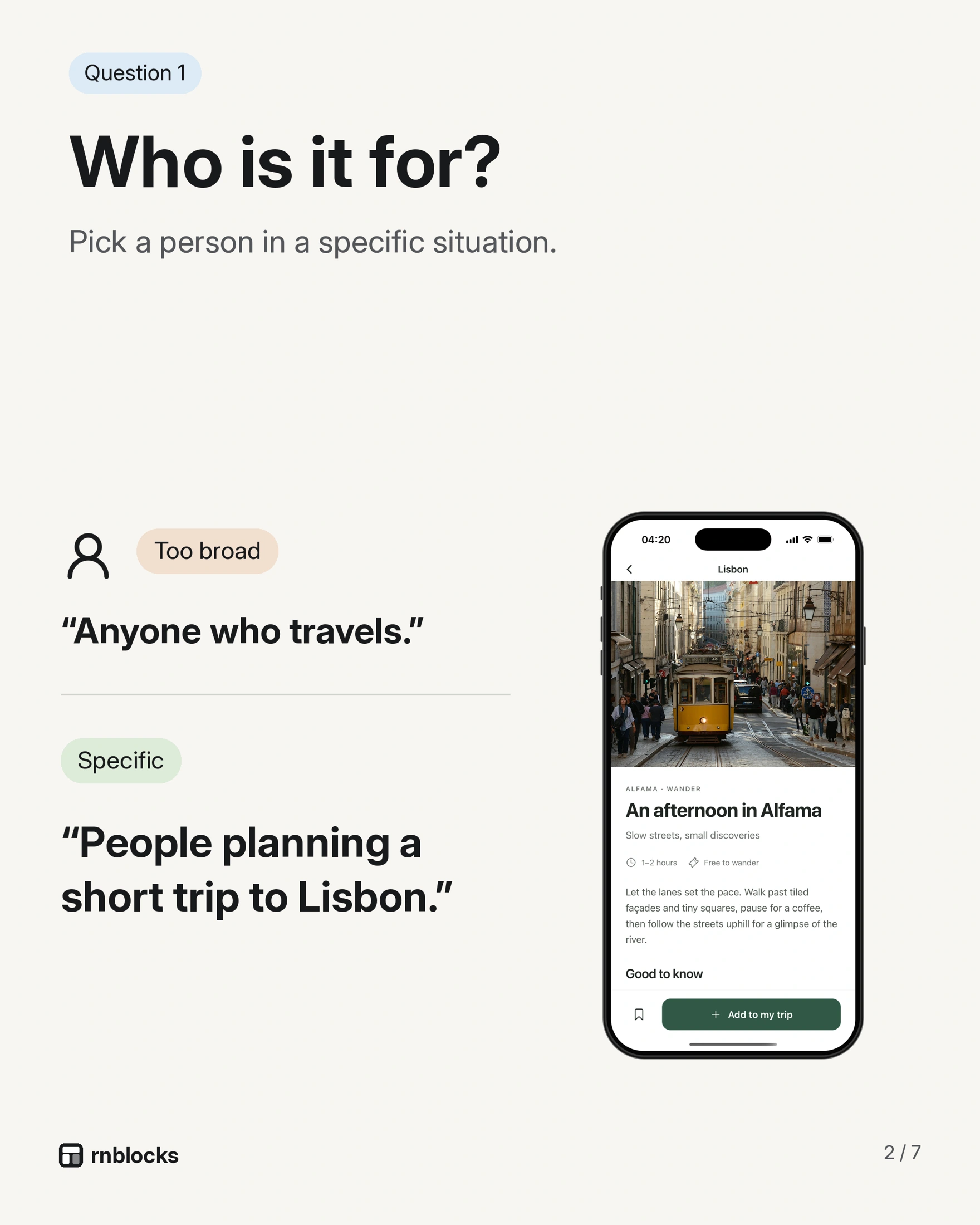
1. Who is it for?
Name a specific person and situation: "Nurses swapping shifts", not "everyone".
2. What is the one main task?
The thing they must be able to finish. Everything else waits.
3. What must be saved, and where?
Should data survive closing the app? Sync across phones? Be shared with others? This decides whether you need a backend.
4. Which services does it need?
Accounts, payments, AI answers, images, maps. Each one has its own setup and costs.
5. How will the first 10 users find it?
A group you belong to, a community, friends in the audience. If you cannot name where they are, start there before building.
Write it in one paragraph
"For [audience] who [situation], the app lets them [main task]. It saves [data] in [place] and uses [services]. The first users will come from [place]."
Turn the answers into a buildable brief
Consider a reading log for a neighborhood book club. The audience is members who want to remember the current book and meeting date. The main task is recording progress and checking the next discussion.
That brief is already more useful than 'make a social reading platform.' It suggests a few screens and leaves recommendations, public profiles and a marketplace out of the first version.
Separate assumptions from decisions
You may know that members use phones but only assume they want notifications. You may know the meeting changes monthly but not know who should edit it. Write down what needs checking before treating it as a requirement.
Ask a few potential users to show how they manage the task now. A group chat may be frustrating because the meeting date gets buried, not because the group needs an entire social network.
Add a small data plan
List the records the task needs: books, meetings and each member's private progress. Decide which information is shared and which belongs to an account.
The same screen can imply different backend work. A public meeting date is simple to display. Allowing only an organizer to change it requires an authorization rule. Private notes need different access from shared discussion prompts.
Include the awkward cases
| Situation | Decide before building |
|---|---|
| No book selected | What the first screen explains |
| Meeting changes | Who may edit it and how others see the update |
| Person replaces their phone | Whether progress follows the account |
| No signal | Which saved information remains available |
| Person leaves the club | What happens to access and private data |
You do not need a long specification. A sentence per important case prevents missing behavior later.
Decide how you will learn
Choose a few people who can try the main task and a clear question for the first test. For example: can a member find the next meeting and record their progress without help?
Set a small scope and a review point. A prototype can sometimes be created quickly, but security, integrations and release readiness can take longer. Do not use an arbitrary deadline as evidence that the idea is too large. Identify the actual work and reduce scope where it makes sense.
End with one usable paragraph
Include the audience, task, saved information, required services and first testing group. Add what the first version should leave out. That last sentence helps an AI builder avoid expanding a clear small idea into an unrelated feature collection.
Do I need a business plan before a prototype?
Not necessarily. A short brief and a few real examples can be enough to begin a small test. You should still understand the audience, task and important risks. A long document is not a substitute for those answers.
Should I choose the name first?
A temporary working name is enough for early testing. Before a public release, check naming, identity and rights appropriately. Do not let branding work replace learning whether the task is useful.
What if the idea needs several services?
List the service behind each requirement and ask whether the first version needs it. Some features can start with sample content; others need a real connection to test meaningfully. Make that distinction visible in the brief.
What does 'saved' mean?
Write whether records survive closing the app, signing out, reinstalling and changing phones. Those are separate expectations. The answer helps determine storage and account work.
What should the first test prove?
Choose a small observable result, such as a member finding the next meeting and recording progress. State what would count as failure. Watch someone unfamiliar with the interface attempt it, then update the brief from what you learn. This gives the next build a purpose beyond adding more screens.
Questions people also ask
How long should a first version take?
It depends on scope, integrations and risk. Set a small testable milestone, then estimate the work rather than promising a fixed number of days.
Should I build for iPhone or Android first?
With React Native you can build both from one project. Launch where your first users are.
Build it with RNBlocks
Use the completed brief as your first RNBlocks request. Start free, build the main journey and test the assumptions you marked. Our agent can help you refine the app through conversation, then continue with release preparation when that becomes the next goal.
Ready to build?
Build, connect and publish iOS and Android apps with AI.